
ATS Resume Optimization: A Recruiter’s Practical Playbook
I reviewed resumes for 20 years. This is the ATS optimization process that consistently improves visibility without making your resume read like a robot wrote it.
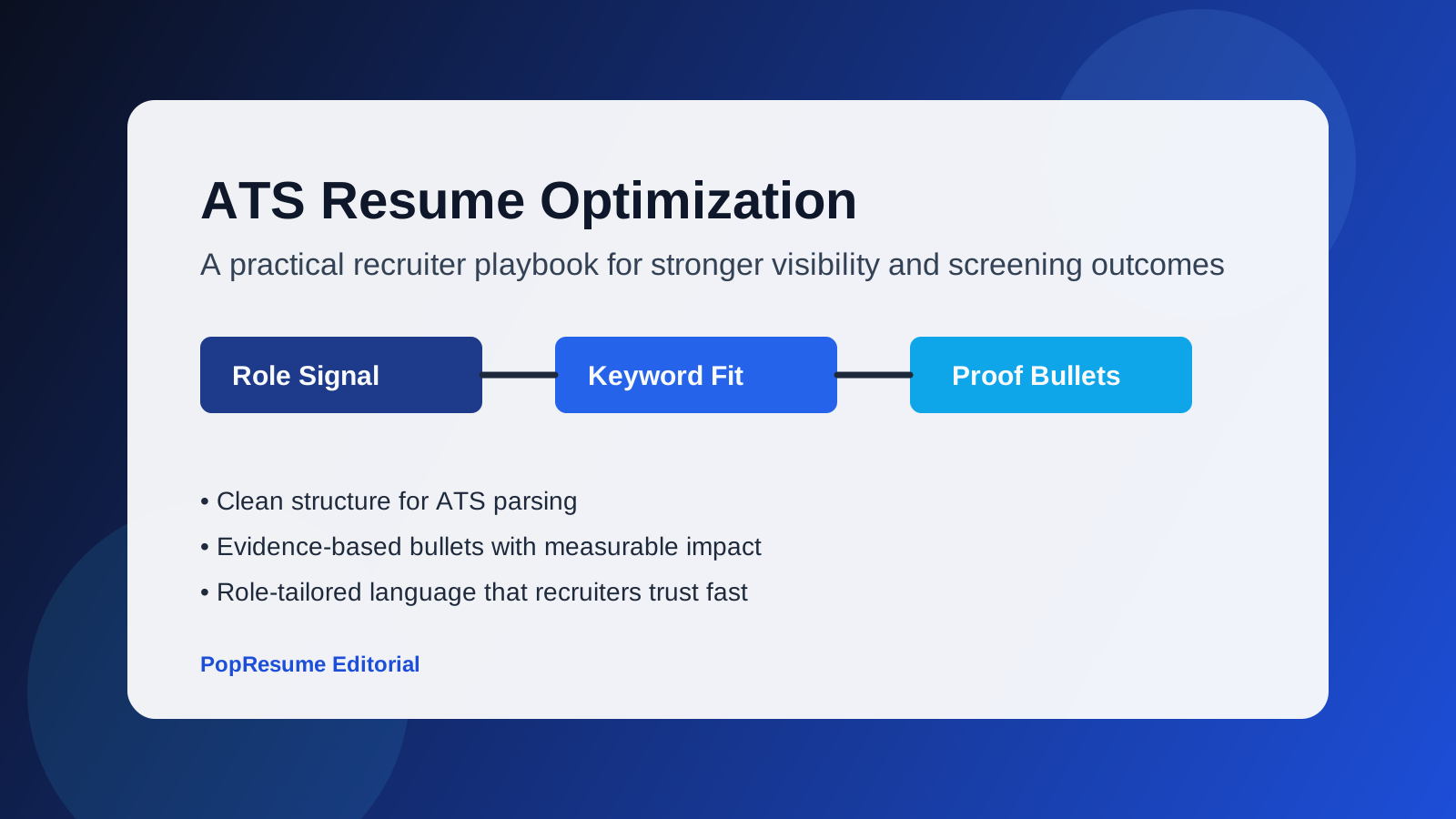
After 20 years reviewing resumes, I can tell you something most candidates miss: your resume is evaluated by process before it is evaluated by person. If the structure is weak, the signal gets lost even when your experience is good.
This guide is the system I would use if I were applying today. It is built to survive ATS parsing, recruiter skim time, and hiring manager scrutiny.
What Happens Before a Human Sees Your Resume
In many workflows, resume screening starts with automated or semi-automated filtering and ranking. Even when a recruiter is involved early, we still prioritize resumes that quickly map to role requirements.
In practice, your resume has to do three things:
- Parse cleanly into predictable fields.
- Match high-intent requirements in the job description.
- Communicate business impact fast.
If you are serious about interview volume, treat ATS compatibility as table stakes, not an advanced tactic.
What I Look For in the First 7 to 15 Seconds
When I scan a resume quickly, I am looking for decision clarity:
- Target role fit in headline or summary.
- Skills and tools that match the posting language.
- Evidence of outcomes, not just activity.
- Recent and relevant experience at the top.
A common failure pattern is a resume that says a lot but proves little. Strong candidates quantify scope, speed, quality, or revenue impact. Weak resumes list responsibilities with no outcome signal.
The ATS-Safe Formatting Rules That Still Work
Use conservative formatting unless the role explicitly rewards design complexity.
- Use standard section labels such as
Summary,Experience,Education,Skills. - Keep layout single-column for maximum parser reliability.
- Use readable fonts and consistent date formatting.
- Avoid text boxes, decorative icons, and image-based text.
- Export in the file format requested by the employer.
You are not trying to win a design award. You are trying to maximize interpretation accuracy.
How to Use Keywords Without Looking Fake
Keyword strategy is not stuffing. It is alignment.
My rule is simple: if the job description repeats a capability, your resume should reflect that capability using the same plain-language term in relevant context.
Workflow I recommend
- Copy the job description into a note.
- Highlight repeated hard skills, systems, and domain terms.
- Map each critical term to one real achievement.
- Update your summary, skills, and top bullets with those mapped terms.
If you cannot tie a keyword to real work, do not use it. Interview panels will test it quickly.
Before and After Bullet Examples
Example 1: Project coordination
- Before:
Responsible for project management across teams. - After:
Led cross-functional launch plan across product, sales, and support, shipping 2 weeks early and reducing post-launch defects by 28%.
Example 2: Recruiting operations
- Before:
Handled recruiting and candidate communication. - After:
Managed full-cycle recruiting for 18 roles in 2 quarters, cutting time-to-slate from 19 days to 11 days through structured screening and weekly pipeline reviews.
Example 3: Marketing execution
- Before:
Worked on email campaigns. - After:
Built segmented lifecycle email program that increased qualified demo requests by 31% quarter over quarter.
These upgrades do two things: they improve ATS relevance and make recruiter decisions easier.
A Week-One Optimization Plan
If your resume is underperforming, use this one-week reset.
Day 1
- Define your target role and level.
- Pick 2 to 3 job postings as your baseline.
Day 2
- Rewrite summary for role clarity.
- Replace generic soft-skill language with role-specific capabilities.
Day 3
- Rebuild top 8 to 12 bullets using measurable outcomes.
Day 4
- Align skills section to repeated requirements.
Day 5
- Run a plain-text parse test and correct formatting noise.
Day 6
- Tailor version A for role type 1 and version B for role type 2.
Day 7
- Run your final resume through our Free ATS Resume Checker and fix high-impact gaps before applying.
ATS Review Checklist
Use this before each submission.
- Does the headline reflect the role I am applying to?
- Are top requirements clearly visible in the first third of page one?
- Do bullets include outcomes with numbers where possible?
- Is the layout simple enough to parse accurately?
- Have I tailored terms to this specific posting?
- Did I remove claims I cannot defend in an interview?
If you can answer yes to all six, your resume is in strong shape.
Final Recruiter Take
Most resumes fail for preventable reasons. The candidate is often qualified, but the document is unclear, generic, or hard to parse.
The good news is that this is fixable in days, not months.
If you want a practical next step, run your draft through the Free ATS Resume Checker, then build your final targeted version in the AI Resume Builder. Track application experiments and callback rates inside the Job Application Tracker so you know what version actually performs.
Sources
Last checked: April 20, 2026.