
Keeping Track of Job Applications: A Recruiter System That Actually Works
After 20 years in recruiting, I can tell you this clearly: candidates lose momentum when they run job search without a system. Here is the exact application tracking methodology I recommend.
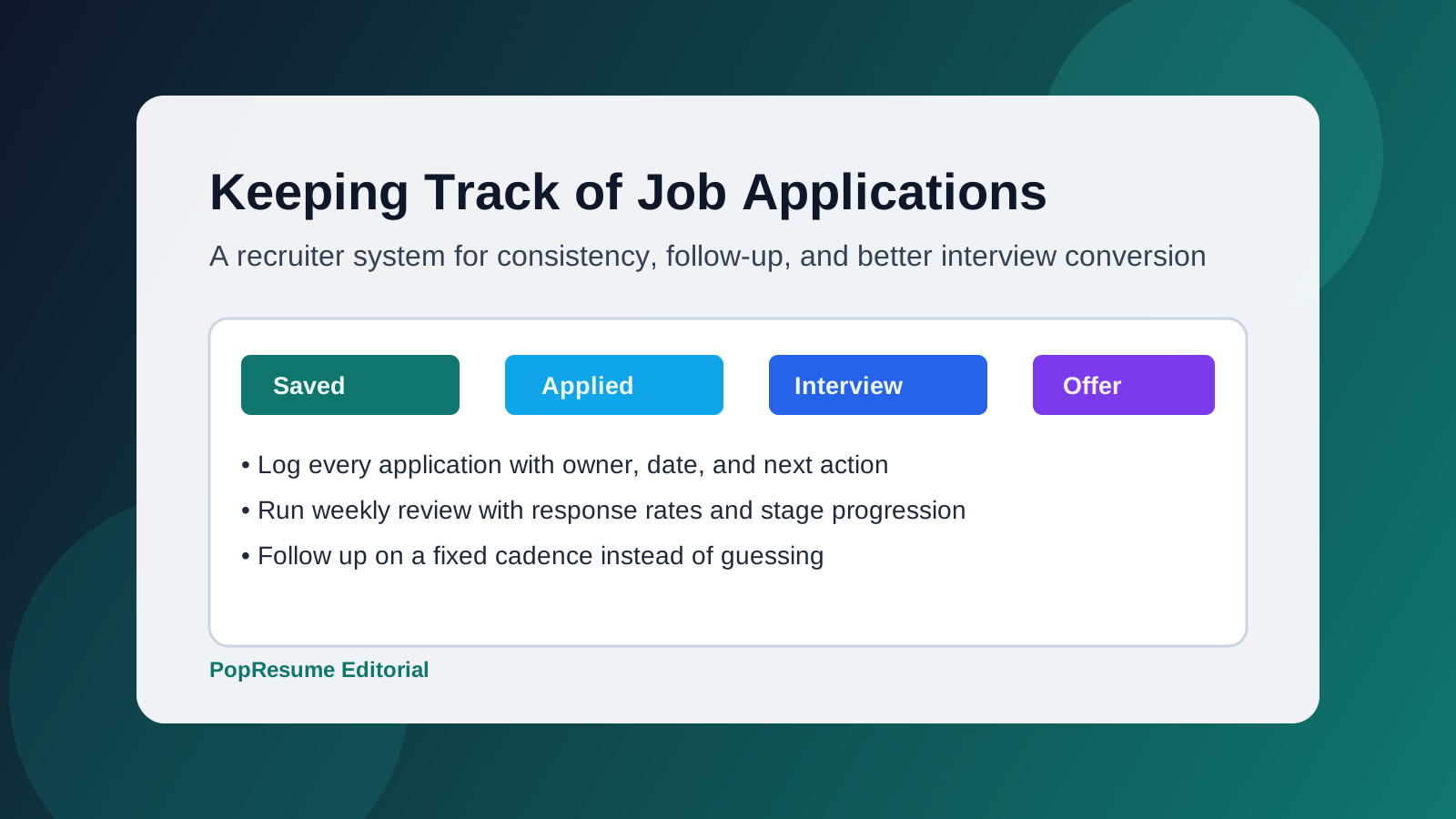
After 20 years in recruiting, I have a blunt opinion: most candidates do not lose because they are unqualified. They lose because their job search becomes chaotic after the first wave of applications.
They forget where they applied. They send weak follow-ups too late. They cannot tell which resume version produced interviews. Then confidence drops, output drops, and they mistake process failure for market rejection.
If you want better outcomes, you need a system. Not a motivational quote. Not random hustle. A repeatable operating system for applications, follow-up, and decision-making.
This is the exact methodology I recommend to candidates who need interview momentum quickly.
Why Most Job Searches Break Down After Week Two
The first week of job search usually feels productive. You update your resume, apply to a burst of roles, and feel momentum.
Week two is where most people lose control. Here is what happens:
- Applications spread across job boards, company sites, and referrals
- No central record of status or next step
- Duplicate applications to the same company through different channels
- Follow-ups sent inconsistently or not sent at all
- No feedback loop on what is working
When this happens, candidates over-apply and under-learn. They increase effort but reduce precision.
Recruiters can feel this on the other side. We get unfocused messages, role mismatches, and poor sequencing. The candidate may be strong, but their process looks undisciplined.
The Recruiter Perspective on Application Tracking
Hiring teams run pipelines. Strong candidates should do the same.
Recruiters do not think in terms of isolated resumes. We think in terms of stages, conversion rates, and next action dates. Candidate quality matters, but process quality matters too.
If your tracking is strong, three things improve fast:
- You follow up at the right time with the right context.
- You stop wasting effort on low-fit applications.
- You know exactly which strategy creates interviews.
In other words, a tracker is not admin work. It is leverage.
If you want a structured place to do this without building your own spreadsheet, use the Job Application Tracker.
The Core System Five Fields You Must Track
You can track many variables, but these five are non-negotiable.
1. Role and company
Log the exact role title, company name, and source link. This avoids duplicate submissions and confusion later.
2. Submission date
Track the date submitted and submission channel. Timing drives your follow-up schedule.
3. Resume version used
Candidates rarely track this, and it is a major mistake. You need to know which version was sent so you can tie performance to content.
4. Current stage
Use simple, objective stages: Saved, Applied, Recruiter Screen, Interview, Final, Offer, Closed.
5. Next action and due date
Every record needs one next action and one date. If there is no next action, there is no pipeline discipline.
That is your minimum viable system.
The Pipeline Methodology That Keeps You in Control
I recommend a lightweight pipeline model that mirrors recruiting operations.
Stage 1: Sourced and qualified
You save roles that meet fit criteria. Do not apply yet. First filter for role alignment, location rules, compensation fit, and realistic qualification match.
Stage 2: Applied and timestamped
You submit targeted applications with role-specific resume versions. Immediately set a follow-up date at submission.
Stage 3: Contact and conversation
Any recruiter outreach, email exchange, or screen request moves the role into active conversation. These require faster response SLAs from you.
Stage 4: Interview cycle
Track interview round, interviewer names, core themes, and prep notes. Strong candidates prepare against known themes, not generic questions.
Stage 5: Decision and retrospective
When role closes, log outcome and reason when known. Then review patterns weekly so each cycle improves.
This structure keeps emotion out of decisions. You are running a process, not just reacting to inbox activity.
The Weekly Operating Rhythm I Recommend
Without a weekly cadence, trackers become graveyards.
Use this weekly rhythm:
Monday: pipeline planning
- Review all open roles
- Prioritize top 10 opportunities
- Set weekly output targets for high-fit applications
Tuesday to Thursday: execution blocks
- Submit targeted applications
- Send scheduled follow-ups
- Prepare for interviews from active pipeline
Friday: measurement and iteration
- Review stage conversion metrics
- Compare resume versions and message templates
- Drop low-signal channels and double down on high-performing ones
Keep your total weekly process review to 30 to 45 minutes. That small investment prevents major drift.
How to Follow Up Without Looking Desperate
Most candidates either never follow up or follow up poorly. Both hurt.
The correct approach is structured, brief, and role-specific.
Recommended sequence:
- Day 0: Submit application with tailored resume.
- Day 7 to 10: Send short follow-up that references role and fit.
- After interview: Send thank-you note within 24 hours.
- If timeline passes: Send one professional status check.
Example follow-up frame:
- Re-state role title and date applied.
- Mention one relevant outcome from your background.
- Express continued interest.
- Keep it to 4 to 6 lines.
Recruiters respond better to focused professionalism than long persuasion attempts.
Metrics That Actually Improve Results
Candidates often track volume only. Volume is not enough.
Track these performance metrics:
Application to recruiter screen rate
This is your strongest early indicator of resume quality and role targeting.
Recruiter screen to interview rate
This reflects message clarity, fit, and first-call performance.
Time in stage
How long roles sit in Applied or Interview tells you where to follow up or reallocate effort.
Source quality by channel
Compare job board applications, direct company applications, referrals, and recruiter outreach.
Resume version performance
If version A gets twice the response of version B, the data is telling you what to scale.
You do not need perfect analytics. You need enough signal to stop guessing.
Common Tracking Mistakes I See Every Week
These mistakes quietly destroy momentum.
Mistake 1: No single source of truth
Candidates track some applications in email, some in browser bookmarks, and some in memory. That always breaks.
Mistake 2: No next action dates
A tracker without due dates is a diary, not a system.
Mistake 3: Overly complex schema
If your tracker has 30 fields, you will stop maintaining it. Keep it lean and operational.
Mistake 4: No closed-loop review
You cannot improve what you never review. Weekly retrospective is required.
Mistake 5: Treating all roles equally
Not every application deserves equal effort. Prioritize high-fit opportunities and move lower-fit roles to secondary queue.
A 30-Day Execution Plan You Can Use Now
If your current process is scattered, use this reset plan.
Days 1 to 3: setup
- Build your tracker with the five core fields.
- Define stage names and follow-up rules.
- Establish two resume versions for your top role family.
Days 4 to 10: baseline applications
- Submit targeted applications to high-fit roles only.
- Log every application immediately.
- Set next action date at time of submission.
Days 11 to 17: follow-up and adjustment
- Execute follow-up sequence on schedule.
- Track recruiter responses by channel.
- Improve weak resume bullets based on low-response patterns.
Days 18 to 24: interview preparation cycle
- For active interviews, log themes and likely evaluation criteria.
- Create role-specific preparation notes.
- Capture post-interview takeaways in your tracker.
Days 25 to 30: performance review
- Calculate conversion rates by stage.
- Identify top-performing sources and resume version.
- Remove low-yield behaviors and double down on what works.
This plan is simple, but it compounds fast. Structure produces confidence, and confidence improves execution.
Final Recruiter Opinion
Job search is not just a content problem. It is an operations problem.
The candidates who consistently get interviews are not always the most experienced on paper. They are often the ones with a tighter system, better follow-up discipline, and clearer learning loops.
If you want better outcomes, run your search like a pipeline. Track every application, assign every next action, review metrics weekly, and adapt based on evidence.
Start with the Job Application Tracker, keep your resume versions clean in the AI Resume Builder, and validate quality before submission with the Free ATS Resume Checker.
Sources
Last checked: April 21, 2026.